Wednesday, September 7, 2011

Η Επιστροφή - The Return (2011) – Part 3 – Ancona to Val Gardena


My day has been frustrating, painful and tiring in equal measure – but it concluded reasonably well.


I woke very early on the boat  - around 5am. The cabin was not as comfortable as the boat I had taken out to Greece and the noise of the engines combined with the rattling of doors, conspired to keep me awake from that point on. Some reading and some reflecting saw me use up two hours before I decided to get up and face the day.

I ate in the self-service restaurant as I had the previous evening. Fresh orange juice, yoghurt, scrambled eggs and bacon  - plus two cups of hard core coffee got me started for the day.

I enjoyed the old man who served the food. He must have been 70 years old and remembered me from the night before. “What to give the young man to make him strong? – for he is a brave young man!” was his greeting at the food counter. I admired his memory, his customer service skills and his love of life. I also enjoyed being called a brave young man, when – at 7am – I looked far from young or brave!

Breakfast dealt with I went on deck and admired the wake left behind the boat and thought of how many things it symbolized. I returned to my room and read Hemingway for a couple of hours before showering and then packing.

I went to the central reception area on the boat to wait for docking. While I was there I wrote about departure and my feelings about leaving Greece.

The boat was late – more than an hour – but I didn’t know this until I wasted an hour standing by the elevator waiting for the boat to dock so I could return to my bike. I whiled away the time writing to friends and moaning about the delay to myself.

Eventually the boat docked and – frustrated and annoyed – I went below deck to my motorcycle and loaded up.

By the time I got off the boat I was at least an hour and a half behind schedule with a long journey ahead. I was annoyed and in a shitty mood.

It took an age to exit Ancona with single lane traffic and lots of it… but eventually I made it to the awful Autostrada and headed north.

Wearing just a t-shirt and some light trousers the initial weather  - sun and a temperature of about 28 degrees – was pleasant.

But the traffic was terrible and worse, there were road works continually bringing the highway to single lane for many kilometers and resulting in me riding between cars and trucks and emergency lanes just to make headway. I was more angry now and in a worse mood. Several times I had to brake hard to avoid collisions with car drivers and trucks.

As I neared Bologna, the heavens opened with a vengeance and I was instantly soaked. The rain came down like stair rods and it felt like being repeatedly shot with a nail gun.  And suddenly it was cold.

I could barely see out of my visor as trucks sped past while I waddled around in the heavy rain of the storm. I was frightened and pissed off that the driving conditions demanded I focus on the road and not the music I was listening to.

Eventually the rain storm subsided and I could see once more. The road was dull and the traffic made it worse. I pressed on, determined to put some kilometers under my belt before stopping.

Eventually I stopped at a truck stop on the highway to grab some lunch and join a conference call of my firm’s leadership group. No rest for the wicked.

I was impressed by the sign at the truck stop. It said that the establishment did not sell alcohol or pornography, but that coffee ordered between midnight and 5am was free of charge. Very ethical and sensible – if ever so slightly incongruous with the world of truckers.

I ordered a piece of pizza and a soft drink and then allowed myself to be persuaded into making it a “meal package” by adding fruit salad. Ha!

I sat and ate quickly while emailing colleagues for updates in preparation for my call.

The man next to me was a large Italian trucker and possible a member of the Mafia by the looks of him. He had three pieces of pizza which he woofed down quickly and then gulped a quick espresso down too. Afterwards he sat for moment, then stood up, farted loudly and impressively, and left. Lovely. I began my conference call and gave my report & update from the car park of the truck stop.

Back on the bike I was still frustrated and not myself. Even the music couldn’t bring me round. The sky was grey and cloudy, threatening more rain at any moment. I was only just drying off from the first storm.

As I passed Verona, a place of much rambling in years gone by, the cloud cleared the temperature improved. I felt better, but not much as the traffic was still lousy – forcing me to swerve and weave among the trucks and cars. But at least the sun was out.

Eventually the sun warmed my bones and I started to settle into a rhythm of riding – and began to enjoy my music, singing along at the top of my lungs to an audience of car and truck bound people, deaf to my joy.

Every part of my body was killing me – back, legs, arms and face – as I pushed myself to complete another 150 kms before stopping briefly to refuel and stretch my legs.

I hate motorway riding at the best of times, but today it was true to say that the first 500kms of my journey were hellish.

Eventually I left the motorway and joined the mountain road to the Brenner Pass (Brennero). Suddenly my whole mood lifted and I was in heaven once more.

Such a gorgeous road, such amazing scenery – and now, few trucks! All replaced by motorcycles. My brothers were in the mountains having fun like me!

I enjoyed the last 50 kms of my ride enormously. While I was very tired, the road and the scenery inspired me – not to mention music which included Bob Dylan, Mark Knopfler, JJ Cale, Lucinda Williams (look her up – she’s amazing), Guns N Roses (try Sweet Child of Mine while riding at 160 kms/hour through a valley surrounded by great rocky mountains!) and an amazing song from Keane (“Somewhere Only We Know” - http://www.youtube.com/watch?v=Oextk-If8HQ )

Lyrics here:


Somewhere Only We Know - Keane

I walked across an empty land
I knew the pathway like the back of my hand
I felt the earth beneath my feet
Sat by the river and it made me complete

Oh simple thing where have you gone
I'm getting old and I need something to rely on
So tell me when you're gonna let me in
I'm getting tired and I need somewhere to begin

I came across a fallen tree
I felt the branches of it looking at me
Is this the place we used to love?
Is this the place that I've been dreaming of?

Oh simple thing where have you gone
I'm getting old and I need something to rely on
So tell me when you're gonna let me in
I'm getting tired and I need somewhere to begin

And if you have a minute why don't we go
Talk about it somewhere only we know?
This could be the end of everything
So why don't we go
Somewhere only we know?

Oh simple thing where have you gone
I'm getting old and I need something to rely on
So tell me when you're gonna let me in
I'm getting tired and I need somewhere to begin

And if you have a minute why don't we go
Talk about it somewhere only we know?
This could be the end of everything
So why don't we go
Somewhere only we know?

This could be the end of everything
So why don't we go
Somewhere only we know?

Another song which I listened to twice was “It’s All Over Now Baby Blue” by Dylan. I love that song and have both played it live and recorded it. Magnificent. (http://www.youtube.com/watch?v=YN25Pp0hrOM )

As I headed into the mountains and climbed, the frustration of the previous part of the day disappeared as I rode across biking Nirvana. These roads were designed by a man who travels on two wheels. No doubt about it.

And as I rose up the cool air filled my nostrils and refreshed my cheeks. All I could smell was pine trees – as though someone had stuffed an air freshener in my nose. With the small difference that this was REAL!

Oh what joy to be on such a road with such beautiful scenery! Small wooden houses, medieval stone churches and endless forest capped by a huge stone mountain. A feast for the eyes.

As I climbed I encountered more and more bikes. At first I felt joy in the camaraderie of the biking community, but then I saw license plates and my nationalism came to a fore – along with my Alpha spirit. Belgians, French and most of all Germans were dispatched dispassionately as I accelerated through the bends, overtaking on blind corners and generally enjoying 15 minutes of being a biker hooligan!

So long guys, I’m heading to the top of the mountain!

Well, near to the top. . .

Mountains - the biker's first love!
I arrived in Val Di Gardena just before 7pm and parked up at my wonderful hotel – The Alpen Royal  - one of the “Leading Small Hotels of the World”.

Val Di Gardena

I looked around at the amazingly beautiful valley and thought two thoughts:


Where are you Julie???

  1. God must have used up most of the green paint on this part of the world. Between grass fields and forest, it was a complete sea of green – refreshing, natural, and wholesome.
  2. I expected Julie Andrews to pop out of the bushes any moment and burst into song!

On check-in, I was given an upgrade to a suite. Nice.

The I was escorted to the bar for a “Welcome Drink”.

5 Star Biker!
As I felt very welcome I had three drinks – pink champagne. They served some lovely nibbles including tomato bruschetta, some local Speck, and some wonderful pieces of aged Parmesan. I consumed and relaxed in the fading sun of the day – content in my Sound Of Music surroundings.

I had a wonderful dinner at the hotel’s gourmet restaurant (more in a separate piece) – and now I lie ready for sleep and to dream of the Brenner Pass tomorrow.

It’s one of the most famous mountain passes in Europe and paradise for bikers!

I can't wait!


Tuesday, September 6, 2011

Η Επιστροφή - The Return (2011) - Part 2 – Αναχώρηση (Departure) Heaney Style


I found this poem by Seamus Heaney in the anthology I am reading. Entitled "Anahorish" - the English transliteration of the Greek word "Αναχώρηση" meaning "departure".

It strikes me as being very true to what I was trying to say in my previous post. . . departure is closely tied to memory.

For Heaney, as for me and for others, anahorish or departure, is a freedom or release. A permission to continue life, to progress, to refresh, to keep momentum, but without having to sacrifice or let go the cargo of memory.

Anahorish

My "place of clear water,"
the first hill in the world
where springs washed into
the shiny grass

and darkened cobbles
in the bed of the lane.
Anahorish, soft gradient
of consonant, vowel-meadow,

after-image of lamps
swung through the yards
on winter evenings.
With pails and barrows

those mound-dwellers
go waist-deep in mist
to break the light ice
at wells and dunghills.

Seamus Heaney, 1987

I love the phrase  My 'place of clear water' 

Departure is indeed a place of clear water.

Η Επιστροφή - The Return (2011) - Part 1 – Αναχώρηση (Departure)


Αναχώρηση - Departure


Greece is behind me. In the past. I have left. I have departed.
I am sad to leave as I found my peace and recharged my batteries there. I thought a lot, I found a lot and left a lot behind me.

Leaving a lot behind me is the essence of departure. The act of leaving somewhere, someone, something, to go somewhere else... Maybe a circular journey, maybe linear.

The destination that follows a departure is somewhat irrelevant. There will be an arrival somewhere, because a departure necessitates an arrival. To this extent it brings a re-birth as one starts the next part anew.

But what we leave behind comes with us. The letter once written then burned in the flame of the candle, remains written. Just the proof of it no longer exists.

The wake of the water behind my ferry boat from Patras to Ancona reminded me of that. There is - for a few minutes at least - a trail that marks where the boat has been. But a few minutes after that the sea closes over and there is no evidence that the boat has been there. It has departed, but it has been there. There is memory of its presence once.

That trail of broken water continually follows the boat. There is continuous departure and continuous but ephemeral evidence, destined to fade - but the truth of its passing as indelible as time.

My departure from Greece has left me with more cargo to carry in my memory, my heart & my soul. That cargo comes with me to my arrival. And in some ways all arrivals henceforth will be marked or defined in some small way with the cargo taken at departure.

Life is a constant acquisition of cargo. While we think we leave some things behind - like the wake of the boat in the sea - we have simply mislaid the evidence. The physical proof. The real essence of the cargo remains with us, imprinted upon us indelibly and forever.

So my sadness at what I leave behind is tempered by a calm knowledge that I have in fact left nothing behind. It is all with me. Every thought, every sensation, every moment. Its physicality less important than its essence. Or in Platonic terms, the idea more important somehow than the form.

Of course Plato's ideas were by definition the ultimate abstract and my memories, experiences and sensations all have a dimension of reality. But in the same way we could never touch the "idea" of a table, only the "form" of a table - in its many expressions - neither can we concretely experience the events of our memory - or indeed re-experience our memories. They become abstracted somehow, to exist in eternity thereafter.

Interestingly, this is not unique to the person remembering. The events of our memory are events which existed in time and context and therefore exist independently of us. They exist for other people as well as independently of all people. In a prism of time and place. It does not require any one single person to experience something to validate the existence of that event – although it may appear to be so.

So my departure was not a part only of me, but a part of others also. And all departures are thus. As are all arrivals.

Whether my road takes me back the same way or not, it will in a sense be a linear journey no matter what - as are life and time. While the same places and people may feature again, it will by definition be new and fresh when I "arrive", the memory of the departure providing context but not prescribing the future.

And for this reason I love arrivals as much as I love departure. Because I love the future. I love that departure leads to arrival. Arrival in the future with our memories as our cargo.

What better journey could one ever make?

Saturday, September 3, 2011

Odyssey - the journey to Greece (2011) - Part 12 – The Art & Act of Compromise


Some friends have come down from Athens for the weekend to enjoy the Parathalasso – and possibly my company – and we began the weekend last night with a big, long catch-up on what we had been doing since we last saw each other (some seven or eight years have gone by).

They are newly married (6 weeks ago), while part of my recounting my tales of the last seven years includes me being happily divorced, so of course the topic of marriage became a major part of our discussion…

Or to put it more broadly, the topic of how to sustain a long-term relationship (LTR).

My contribution was more focused on what NOT to do, while theirs was a little more positive. 

After discussing matters such as character, values, background, interests, maturity and so on, we all centered on “compromise” as perhaps one of the key requirements of a successful LTR (or marriage).

So what does compromise entail? What does compromise require? What is the nature of compromise?

Looking at how compromise is defined is a good place to start:

com·pro·mise noun \ˈkäm-prə-ˌmīz\

1.              A settlement of differences by mutual concessions; an agreement reached by adjustment of conflicting or opposing claims, principles, etc., by reciprocal modification of demands.
2.              The result of such a settlement.
3.              Something intermediate between different things - the middle ground.
4.              A concession to something derogatory or prejudicial: a compromise of principles


In broader terms compromise is described thus:

To compromise is to make a deal where one person gives up part of his or her demand. In arguments, compromise is a concept of finding agreement through communication, through a mutual acceptance of terms—often involving variations from an original goal or desire.

Extremism is often considered as antonym to compromise, which, depending on context, may be associated with concepts of balance, tolerance.

In the negative connotation, compromise may be referred to as capitulation, referring to a "surrender" of objectives, principles, or material, in the process of negotiating an agreement. In human relationships "compromise" is frequently said to be an agreement that no party is happy with, this is because the parties involved often feel that they either gave away too much or that they received too little.

While we are prepared, and indeed usually keen, to find compromise in our business lives we seem to find it more difficult to achieve this in our personal lives.

In business, compromise is described – somewhat euphemistically perhaps– as “win-win”. It is desirable – indeed, it is a goal.

However, compromise in our personal affairs seems all too often to be characterized as “lose-lose”.  Why is this?

I think in our personal relationships we tend to see compromise as concession or capitulation more than we see it as “winning agreement” or finding an acceptable solution. But it shouldn’t be this way and it needn’t be this way.

In Freudian terms, we can probably make the safe assumption that compromise is ultimately delivered by the “SuperEgo”.

While the Id is our pure, unconscious nature based on the pleasure principle – by definition selfish and potentially destructive - the “Ego” is our reality principle, mediating between the needs of the “Id” and reality to avoid conflict or disaster. Meanwhile the “SuperEgo” is the corrective principle that works against the Id and counterbalances. It is the “conscience” that we all have.

The enlightened awareness of the implications of our “self” and its actions.

In philosophical terms the Ego is our “self”. So the corrective influence of a higher principle (the SuperEgo – or, more simply put, appropriate ideals) by definition means thinking beyond one’s self. This is perhaps the most basic driver of compromise – to think beyond one’s self and one’s own needs. The motivation for which is defined by the desired results the compromise – harmony, peace, progress, reconciliation etc.

In business we do this because we recognize that any deal has to make sense to both sides, but I would argue that in our personal affairs not only the same principle applies, BUT that there is an additional dimension . . .

By this I mean that in our personal relationships, preparedness to compromise is in itself an act of love. Beyond the pragmatic requirements of a relationship, which lead to the road of compromise, there is also the statement that compromise makes. “I love you enough to put myself second and to find a middle ground”. Assuming the affection and emotion is mutual then the reciprocation of the act of compromise will always ensure that there is balance and no-one feels it is a “lose-lose” situation.

So we can conclude here that compromise in a LTR is not only a requirement for sustainability and continuity, but it is a desired and desirable component to fully express our love and affection for the other person. However, there is the caveat of mutuality and reciprocation. If both parties are not equally committed to each other – and therefore both motivated to put the other first as an act of love and compromise to not only find a solution but also to express their love, then there will be an imbalance and someone will lose . . . and ultimately, if this balance does not self correct, the relationship is doomed to unhappiness or failure.

So how does this work in practice?

As I am in Greece it seems fitting to have a go at using dialogue to develop the theme a little . . .

Dave: “As newly-weds, what do you think is the key to a successful and happy marriage?”

Iris: “I think it is a number of things. Certainly it’s a matter of personality and character. Not that you have to be the same, but you have to have some harmony. Enough things in common, and enough differences to provide interest.”

Giannis: “A common “culture” or way of living together is important. It takes time and effort to find this, but it is key.”

Iris: “I think there needs to be some maturity also. It is easier to be happy and successful in a marriage when you have lived a little.”

Dave: “But maturity isn’t about age only. I know people who are happily married from the age of 25 or younger – they obviously had some kind of maturity to manage their marriage successfully, no?”

Giannis: “Maybe, or maybe not – they could have just had a very harmonious connection, a good balance and have therefore matured together over time.”

Dave: “I think values are very important. Shared and common basic values are crucial. Our values are truly embedded in us from our childhood, our parents, our surroundings. If these are not broadly shared between two people it will be very difficult to accommodate the difference as our values are perhaps the hardest thing for us to change.”

Iris: “You’re right. Values are very important – and they are a part of your personality and character. To this end it is important that the two personalities are compatible. It’s not about whether he likes motorcycles and I like shopping, its about the value system we share as people. But there will always be differences between people no matter how much they love each other.”

Giannis: “Yes, but this is where we have to find compromises. It’s always a question of compromise.”

Dave: “You are right. Compromise is perhaps the greatest challenge to and the greatest requirement for a successful marriage or relationship. Failure to find appropriate compromise was a major factor in the failure of my first marriage.”

Iris: “As we grow older it is easier to compromise  - our maturity helps us in this regard. We are less selfish, less in a hurry, more patient, more tolerant because we have lived more.”

Giannis: “I disagree. I think as we grow older we become less flexible, less prepared to compromise because we are set in our ways. We are used to doing things the way we want. It’s difficult to change that or accommodate others as you grow older.”

Iris: “But if you are older, more mature, don’t you become less rigidly attached to your ways? After all, you have had it “your way” for a long time, so isn’t it easier to let go of that for the sake of the other?”

Dave: “I think you are both right. As we grow older we are more certain in who we are and of course that means we are more rigidly defined as people and more clear on what we want and don’t want, but I also agree with Iris that as we grow older we also attach much less importance to our habits and preferences, because we don’t feel threatened by change or submission, or compromise. We are used to it, and indeed embrace it.”

Iris: “Yes, that is true. We do feel less frightened of compromise – both because we understand the benefits it can bring and because it is more comfortable for us to give up some things for the sake of compromise then when we are younger and less certain of ourselves.”

Giannis: “True. While I know what I want, I also know that I can from time to time give it up for the sake of someone else, or meet in the middle. It is easier now then when I was younger.”

Dave: “So compromise is easier as we mature and grow older because we are more sensitive, although the need for compromise perhaps becomes greater because we are more set in our ways and clearer about what we want and need. Interesting.”

And so we concluded our discussion fuelled by much local wine.

Compromise is more necessary as your needs and priorities are clearer, but easier to reach with time and experience aiding you in the giving up of certain things. And in LTRs and personal relationships the art of reaching compromise is also the act of showing selfless love for someone else. Achieving this balance will create a happy and sustainable co-existence - provided it is reciprocal and achieved through mutuality.

When I was young and foolish (i.e. more foolish than now), I used to find compromise compromising. I have matured over the years and now see it not as an enemy to harmonious and happy existence but as a necessary precursor to it.

Compromise is not weakness. It is love.

Plato might be proud.


Friday, September 2, 2011

Odyssey - the journey to Greece (2011) - Part 11 – Instinct & Intuition


Despite a comparatively late night, I woke up early this morning, felt very awake and lucid, and thus decided to see the day break – something which I usually do at least once while on vacation, although usually it precedes sleep rather than follows it!

Sunrise over Monastiraki
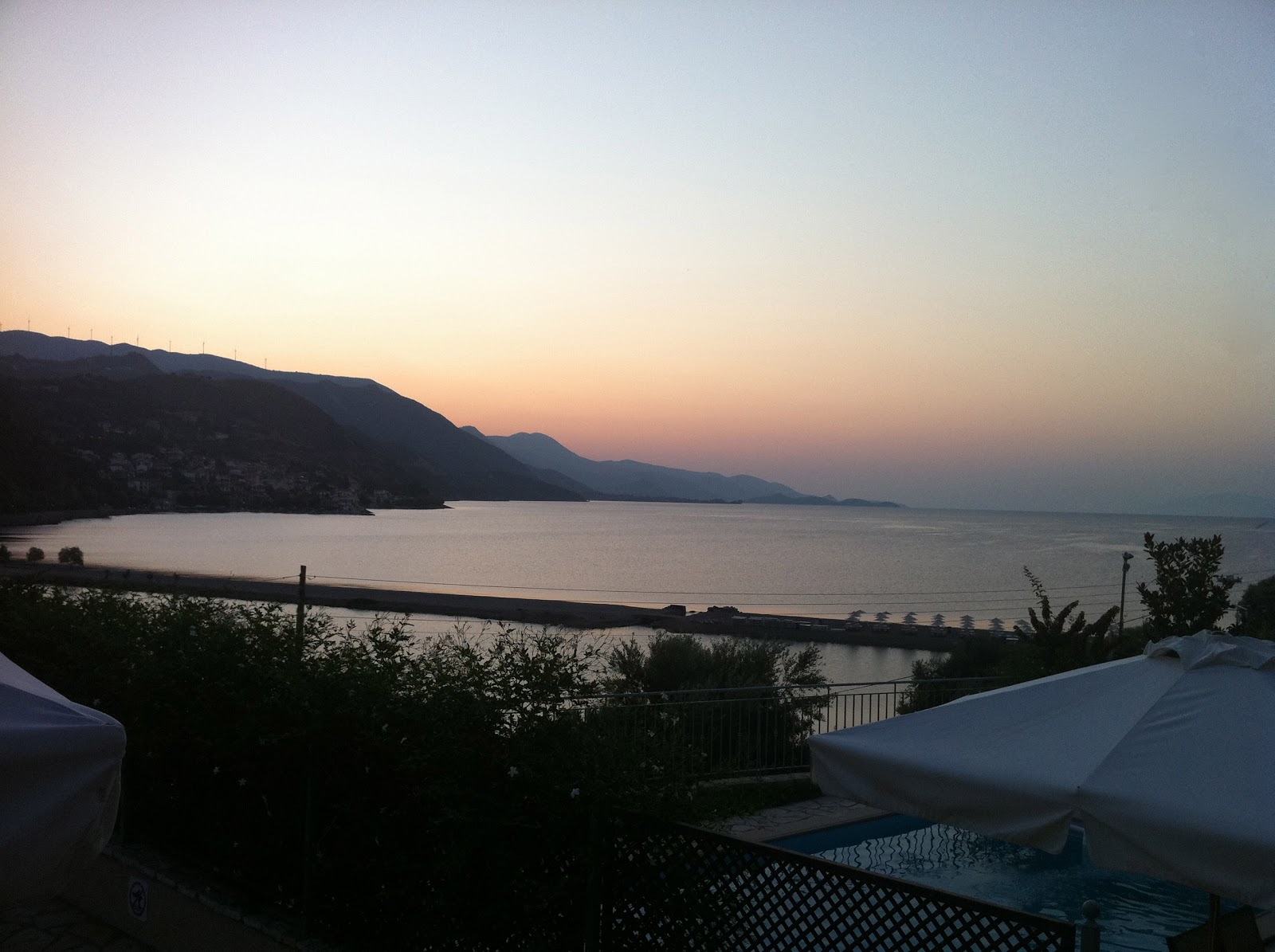
The sea is perfectly calm  - like oil as the Greeks say – and the sun is rising up slowly over the far off mountains on the other side of this little bay on the coastline. Shades of pink and orange emanating like a halo from the hills in a splash of colour that would have pricked the interested of J.M.W. Turner.


The noise of an occasional car and the pump for the swimming pool compete with the early bird song while a small fishing boat glides across the water in the distance.

Peaceful, idyllic and refreshing.

As I come towards the end of my time in Greece – and thus most likely towards the end of the more philosophical pieces of writing  - I wanted to devote a little time to the topic of instinct & intuition. Something of a follow-on from my piece on “connections”. (http://osapp.blogspot.com/2011/09/odyssey-journey-to-greece-2011-part-10.html )

These two methods of interpreting the world and making decisions are my two most prized. According to the psychometric tests I am a highly intuitive person, while according to experience I use my instincts more than I use my logic. Logic and reason really often only being used to post-rationalise or justify why we’re going with what I am sure is true / right in the first place. . .

Defined as the ability to acquire knowledge or directly perceive truth without the use of reason, intuition takes up a special place in Jungian psychological theory.

“Jung said that a person in whom intuition was dominant, an "intuitive type", acted not on the basis of rational judgment but on sheer intensity of perception. An extraverted intuitive type, "the natural champion of all minorities with a future", orients to new and promising but unproven possibilities, often leaving to chase after a new possibility before old ventures have borne fruit, oblivious to his or her own welfare in the constant pursuit of change . . . Jung thought that extraverted intuitive types were likely entrepreneurs, speculators, cultural revolutionaries, often undone by a desire to escape every situation before it becomes settled and constraining—even repeatedly leaving lovers for the sake of new romantic possibilities. His introverted intuitive types were likely mystics, prophets, or cranks, struggling with a tension between protecting their visions from influence by others and making their ideas comprehensible and reasonably persuasive to others—a necessity for those visions to bear real fruit.” (http://en.wikipedia.org/wiki/Intuition_(knowledge) )

It struck me that following the topic of my previous piece on “connections”, it may be that the attraction to “random” people is perhaps driven mainly by intuition and instinct.

Intuitive people tend to see patterns in things that rational people do not. Rational people use data, focus on detail and are characterized in psychological terms as “sensing”, and “left brain” compared to the right brain approach of intuitive people.

Following this logic it would seem that rational people would automatically prefer the connections with people that are built on the logic of structure and obvious context – the “institutional” connections I referred to previously. While intuitive people would in fact see the same attractions in what appear to be random people – because they can see something in them that has no basis in - as yet experienced - fact. In other words, there is no empirical evidence to suggest any reason for connection, but yet, there is clear and obvious motivation for the connection for the intuitive person. It makes sense to them. Kismet. It is our destiny to know these people – even though on the surface there appears to be no reason or rhyme.

So in this sense there is really nothing random about the connections that intuitive people make – the connections just appear random when logic and rational thought are applied to understand them.

For intuitive people, the “random” connections are usually with people who actually strike some kind of a chord that is somewhat akin to “memory”. The patterns we perceive in the “random” person are familiar, resonate, and are therefore trustworthy as they align with other patterns that are already familiar to us. We “remember” the random people we meet although we have never met them before.

Most of this seems to happen unconsciously and therefore provides a “high” of excitement as we discover someone we were in fact destined to know from the outset. The only random part is the initial contact that prompts the transmission of the signals (VIA) which the intuitive person can pick up and which the rational person may not – or at least not so easily.

Intuition and instinct in decision making (c.f. “Blink”) is similar. We see a pattern, we recognize it somehow outside the boundaries of logic and rational thought, we align it with patterns we know, and we feel the necessary comfort to make a decision and take a risk. The risk appearing in factual terms to be much larger than we actually feel it – because we have intuited the decision and have already underpinned it with our “knowledge” gained from our intuition.

So when it comes to intuitive people, not only are “random” connections less random than I thought, they are also less “risky” as the intuitive person knows somewhere inside that the risks are in fact much less than they might at first appear to the rational mind.

The use of intuition to determine and decide connections with other intuitive people would also explain the rapidity and intensity with which those connections develop. They can speed ahead in their connection and relationship because many of the normal precursors to forming a connection with someone are already verified, ratified and certified by the intuition of both people.

However, when an intuitive person forms a connection with a rational person, it is less rapid, for while the intuitive person is already sold on the idea, the rational person is still processing factual data to contextualize what the intuitive person has already “seen” and felt.

The note of caution of course comes in the assumptions that intuitive people make which prevent them from even the most cursory verifications once a connection has established.

I have had many relationships / friendships where there is an assumption that everyone is on the “same page” but in fact it isn’t necessarily true. What creates a connection isn’t necessarily what can sustain it. And here both intuitive and rational people have to recognize the need to verify – through listening, attentiveness, questions, and remaining free enough in mindset to adapt to the “reality” of the developing connection. If not, then things can go wrong quite quickly!

Finally, the intuitive people have strong instincts for the “next thing” and as such are often looking to depart quickly from the present to arrive in the future – as such displaying enormous capacity for change, novelty and diversity – to the extent that rational people have difficulty understanding their ability to do this.

While this energy for constant departure and arrival can be very powerful in a positive way, it can also be destructive if unchecked. Sometimes we don’t need to depart to find something new. Sometimes we can stay and find new things where we are or with the people we are with – and that can be equally nourishing and rewarding. But it requires self-discipline and self-awareness – and total honesty with oneself, and usually with others – otherwise we can get into a mess, replace intuition with wishful thinking and generally cause misunderstanding.

So to intuitive people reading his, it probably all makes total sense and is obvious. For rational people, welcome to our world. We’re not crazy, adrenaline junkies with no staying power. We’re just massively curious about the possibilities of life and hungry to understand them. What frightens you or makes you feel uncomfortable, makes us tick, gives us fuel and energy and is necessary for us to sustain life.

But we know that to get along with everyone, we need to slow down, take stock sometimes and understand that what comes naturally to us, does not come naturally to everyone – and more importantly that rational people’s ability to sort fact from fiction, to understand the finer details might be something we can very usefully learn from.

Just the other day I intuited how to use a cooker in my villa when I found out how to make the dial come out of the face of the cooker and turned it to “bake”. Happily a rational person was close by and reminded me that I also had to turn the cooker on, and not just dial the setting . . . our delicious pastourmadopites took a little longer to come to the table that day, but when they did it was a triumph of rational thinking over intuition!

Search This Blog